Episode Transcript
[00:00:00] Speaker A: We have to show people they're valued. We have to make the connection, even if it's only occasional, between their work and the ultimate goal. And it sounds so simple, but, you know, often managers don't do it.
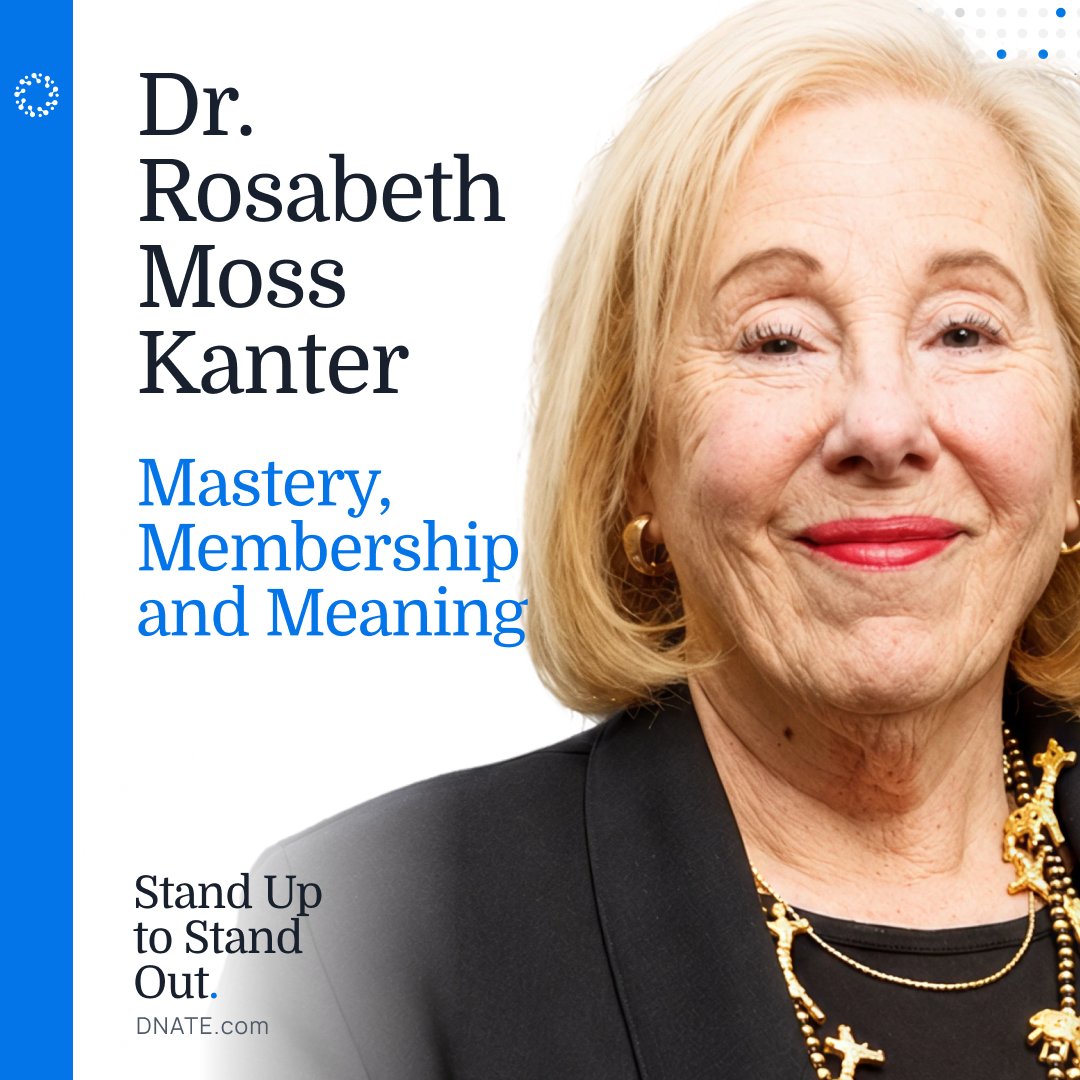
[00:00:15] Speaker B: Welcome to Stand up to Stand Out. My guest today is Dr. Rosabeth Moss Kantor. She is the Ernest L. Arbuckle professor of Business Administration at Harvard Business School, a former editor of the Harvard Business Review, and the author or co author of 20 books, from the Change Masters to Confidence to Think Outside the Building. She has spent 50 years on a single question, why organizations resist change and what it takes to move them. And she is the one who taught a generation of us that it is not power that corrupts, it is powerlessness. I am Stuart Papp, founder of DN8, and welcome to Stand up to Stand Out. The podcast communication has changed, changed my life, and it will absolutely change yours, because breakthrough innovating deserves breakthrough communicating. Every episode we bring you industry insiders, subject matter experts, and you can learn from my decades of experience to get the most practical and tactical advice that you can put to work. Now let's dive in to today's show.
Dr. Kantor, welcome to the show.
[00:01:25] Speaker A: Thanks very much.
I'm looking forward to the conversation.
[00:01:29] Speaker B: Let's start at the beginning. You know, before the books and being at Harvard, you were a young sociologist. You were studying communities and what holds them together. I'm curious at what first attracted you to this work and what you learned in your earlier career.
[00:01:44] Speaker A: Right. Well, I was interested in organizations, but it was a time when people were also searching for new ways to live together to improve the world. And so I looked at a set of communities and was interested in commitment, why people were more committed under some circumstances than others. And I found a number of things that were important that I later applied to the business world.
So later I called these the three M's of motivation, mastery, membership, and meaning. It was very important that people were in positions where they felt they would achieve something. They would achieve a goal of their own, they would grow in skills, or their investment in this particular organization or community would pay off.
The second was membership that people felt that they were part of something, a group, and that their particular individuality was acknowledged, but they were also part of a group in which the culture was important.
And the third was meaning. And so that was the one where what the people were searching for back then, still searching for now, the idea that there is some way of having an impact on the world that's meaningful, a sense of Almost spirituality, investing the community or the organization with a set of larger values. I called it transcendence.
And I found that that was just as important in tech companies as it was in intentional communities.
And although intentional communities, because they often had religious beliefs, stay together a lot longer, the commitment factor in most modern organizations is much shorter. But I think that's in part because some of the other M's are neglected. You know, that people don't feel that sense of belonging or that sense of mastery and meaning, the idea of a grand purpose that we all pull together for, you know, that's not always something that companies are able to produce.
[00:04:13] Speaker B: So if I look at that as a triangle of mastery, membership and meaning, my first question is, did you find, or do you find that they have to be somewhat equally represented to sustain your participation in an organization, or is it not that simple?
[00:04:32] Speaker A: Well, that's a really great way to think about it. I think about it a little more like a hierarchy, that mastery is just like a minimum. And most companies that are any good offer their people a sense of mastery, that, you know, your skills can grow and you apply your skills. Membership is a little more problematic. You know, whether there's a peer group that supports each other and whether the company supports people in their individual needs. And then meaning is a lot harder because companies can have mission statements and people don't believe them. I mean, they're just words.
And so having it actually mean something is a lot harder. And I cared about the third one a lot. Does it actually mean something?
Is the organization trying to make a difference in the world? And you asked how I started out. I mean, I was very interested in all ways in organizations, society, the country, how we make sure that we live up to our own best selves, so to speak.
[00:05:47] Speaker B: I'm relating the part about meaning to something that Daniel Coyle wrote a few books on culture, and he has a book called the Culture Code. And there are three particular ingredients that go into high performing cultures, but the third is purpose. And so I'm. I'm connecting what you're saying as meaning to purpose. Are they connected or correlated?
[00:06:09] Speaker A: I think they're the same thing. I was looking for three M's. You know,
[00:06:13] Speaker B: I
[00:06:14] Speaker A: was looking.
[00:06:14] Speaker B: I love,
[00:06:15] Speaker A: love
[00:06:15] Speaker B: the alliteration.
[00:06:16] Speaker A: Yeah, well, look for a way to make it memorable. And I found that's a way to just make it easy to stick in people's heads. But meaning, a sense of purpose, something a little bit more than just the transaction of the moment. And I've always written about that. Balance between the transaction of the moment and the higher purpose, the grand purpose, because you need both.
You can't live without the immediate reward or gratification.
You can't live without the mastery part. Am I using my skills? Am I getting paid fairly? You know, the compensation, very practical, very utilitarian, meaning purpose is a lot more ineffable, harder to measure, but it matters a lot to people
[00:07:11] Speaker B: what I'm thinking about, especially in biopharma. You know, I noticed that a lot of people in industry lean on meaning because they feel as though what they're doing, they will bear the burden of, you know, a workplace that may be less than perfect or maybe not meritocratic or, you know, they have to ignore some of the mastery components, but they always over index on that sense of meaning that I'm doing this in service of, you know, patients with unmet needs. And I think that that, while honorable, also can lead to burnout and sort of turnover. Does that seem plausible?
[00:07:51] Speaker A: Yeah, that's an astute observation. People feel, well, if we're doing something really noble for a noble purpose, then I can treat you badly and get away with it because after all, our purpose is so noble. And that really misses something that while the noble purpose, you get up every morning and say, I'm going to work because I care about patient health. But you can't see that. You can't see that for a long time and sometimes you're not in direct contact with it anyway.
So to have that become more than words. If we really believe in valuing human life and human dignity, then we have to value it in the workplace too.
So I think that even people with the grandest, most beautiful purpose, to save lives, to improve lives. And believe me, biopharma, biotech, so important, should also care about the dignity and the lives of the people that work there, regardless of their level. I remember in a company that offers custodial services, including the hospitals, service master and service master had a big service value. They also made sure that the janitors who were sweeping up floors in hospitals and sometimes doing kind of dirty work felt that what they were doing was incredibly important and really valued because. Because it was connecting somehow to the grander purpose.
[00:09:31] Speaker B: I think it's important too. You know, I work with a lot of teams who will be in a function that feels nine or 10 steps away from patient impact, and they're in between, you know, forces that they have no control over, insurance companies or payers or what have you. And I really empathize because in some ways they're doing the work that is not seen, not terribly appreciated, but is so fundamental to aligning to ensure that the system rewards this innovation, that the, the medicines or therapies reach patients. And so I think it's important.
One of the things I'm, I'm resonating with, with your 3M model is that all of these are important to ensure that someone feels that every day they can show up and do their best work. And then every week, every month and every year, because it's a long term game, it's a 10 year game, it could be 20 years even. So you really have to be in it for the long haul,
[00:10:33] Speaker A: right?
That's really wise. I mean, we have to show people their value. We have to make the connection, even if it's only occasional, between their work and the ultimate goal. I'm a big believer in appreciation and awards and recognition. And it sounds so simple, but often managers don't do it. I wrote a column once, more popular than I would have believed, had a list of 40 Ways Managers could say thank you. And they included simple things like cooking breakfast for people before work. Very simple things, easy to make up. And I had an executive call me from a large company and maybe it was even a pharmaceutical company. He called me and said, could I come and give a training session on how to say thank you?
I said, well, it's kind of easy. You just say thank you. And he said, that's more emotion than our managers are accustomed to expressing.
[00:11:40] Speaker B: Okay.
[00:11:41] Speaker A: And so we have to express it and make it explicit. And also, you know, there goes a long way to take people once a year, once every two years, to see actual people who are likely to receive the services. Have everybody see that. I mean, that goes a long way. People remember those things for a very long time. And then also that they actually do have skills in their job. I mentioned the cleaners in hospitals. This company made that a very skilled job. And there were levels of skills and you could master each tier. I mean, there's no job that doesn't have in it a sense of dignity and increase in skills.
[00:12:35] Speaker B: I've seen that where people feel truly connected to the mission, that they feel that what their work does matters. And that is really important. I've studied a lot of the psychology of incentives and that people will eventually hit diminishing returns of working harder because they don't feel connected to the mission or the purpose or why we're doing this.
And so it's really important.
[00:13:02] Speaker A: It's also important for people to show up Every day because they can say, well, it doesn't matter. I mean, I found that in high performing organizations or teams, including my studies of sports, that people had to feel they mattered. Because it's in high performing or, you know, winning streak teams, people felt if there was a problem, their presence mattered. And so maybe they're feeling a little under the weather, a little tired, they had a busy weekend.
And so it's so easy to call in sick or to stay out.
When people are totally believing in the mission and also believing in their team, their membership, their fellow members, they are more likely to overcome the, their own objections to getting up and going to work every day. And those tend to increase the high performance.
[00:14:02] Speaker B: You know, I work and I'm lucky enough to work with, with wonderful people in biopharma, people who have soul and care about patients and, and join industry to, for one word, Rosabeth, and that's to drive impact. And that means something different for everybody. But a lot of my, my clients will leave a private practice or working in a hospital where they're at the bedside with patients and they'll join an industry of five thousand or fifty thousand or a hundred thousand.
And all of a sudden you're in a large matrix organization where you know that the scale of impact can be outsized, but you also feel like you've gotten 10, 50, 100 steps away from the patients. And so what I'm getting here is just really keeping that sense of meaning front and center, whether that's, you know, visits connections with, you know, bringing patients in, going to visit, whatever that would be.
[00:14:56] Speaker A: Yes, absolutely. And it's easy to feel lost in a bureaucracy. It's easy to feel that you as one person doesn't matter as much even if you have a team reporting to you. And because, you know, all of this cascades, culture cascades from the top, but it's manifested in daily actions of everybody around you.
So it's up to everybody. I mean, people at the lowest echelons are also culture builders by their actions. And so this all feeds on itself. And your own team, the people you work most closely with has to have a sense that not only can they contribute, but also they are cared for and their needs matter.
[00:15:50] Speaker B: So you said something that I want to pull on, which is culture cascades from the top, but then there's agency at all levels to create culture. And this is something I see over and over again where a team or a new team will look around and they'll say, we need to create some sense of psychological safety. Some high performing culture here because we're not seeing it reflected in our function or in this vertical or what have you. Could you talk about what, what teams can do at their level to affect culture and to strengthen their culture in an organization that may not be communicating that these values are as important to the entire many.
So, you know, I don't want to put them at odds, but you have to have a sense of agency where you are to say let's, let's make sure that our team or our function feels like we are able to do our best work because that is the purpose of an organization. Let's do our best work together. Could you talk about. Yeah. What you've seen.
[00:17:00] Speaker A: Totally true. That every team has the opportunity to also shape the culture for themselves and be a model for others.
And you know, in some companies there are outlier teams that are very close knit, high performing, often outperform those around them. And they've explicitly decided to emphasize their values, to look at how they're working together, to value their own teamwork and contributions and to want to share that with other people, with other teams from the rest of the organization. There are always some like that, even in the worst organization.
Sometimes I found that people like that are at the periphery, they're far away from headquarters and so they're able to create things for themselves out in their unit. And that's often a source of change.
That model, if it's recognized and acknowledged, often becomes a model for the rest of the company if people elsewhere are receptive. I worked with the company once, a North American company, not unfortunately in biopharma, but another tech field where they were studying. They decided to study which were their highest performing manufacturing facilities.
And they found out that their highest performing factory was in Turkey and it had a very arrogant CEO who felt he knew it all. I mean, I liked him, but he definitely was a little arrogant. And, and when they discovered that team was in Turkey, I said to him, well, are you going to send your executive team to go out and visit that factory to see what they do well? And he said no, we'll bring them into headquarters.
Whoops.
If also it's up to top management to find out what parts of the organization reflect the culture, reflect high performance and go to them, not force them to come in and give their slideshow to everybody else. I mean, the more we make it human and connect now, it's easier with our technology.
Like you and I are sitting not very far from each other geographically, but in two different places. And yet we're able to connect. It's still not the same as being there to see it yourself. The ability to travel and observe.
So one thing a team can do is invite others, have a little seminar with reception, say we'd love to share what we've been learning and invite other people to come and feed them a little bit. Everybody in an organization, just about.
There are always exceptions, but just about everybody has convening power, the ability to gather other people to discuss issues.
And so you can't be afraid to do that. Like it's not in my authority. Of course it is. Invite people to just come by your offices for a little discussion of how we're doing with respect to our mission. Or sometimes a book club or another occasion where you're actually connecting with other members of your organization while making your own team feel very special.
[00:20:47] Speaker B: I love that you're inspiring me with, with lots of ideas because I want to pass that inspiration on to my teams who feel, and I know, I know what's happening. They feel like they're stuck between forces that are beyond them. External partners, internal partners, leadership.
And they also don't feel a sense of agency or autonomy to, to, to, to affect change.
And I, what I'm hearing you say is in these, and I'll call them micro experiments, you know, a book club or a show and tell or a, you know, whatever, a values fest. Let's have lunch and talk about the most important values. Write them on the wall and, you know, whatever they would be.
These are ways that you can take small steps that can have outsized returns because it starts, it starts the discussion, but it also gives you a sense of control over your future and creating the culture that you want to see.
[00:21:48] Speaker A: Yes, absolutely. And they do seem small steps and things like throwing a party.
Well, it's kind of important. Human connection and, you know, we're all too busy. That's true. Everyone's overloaded these days. And there are lots of forces outside of our control, particularly in biopharma, biotech, I mean, subject to political whims. That's a big one. Out of our control.
Maybe your government relations department's doing something, but I doubt it.
The uncertainty of discovery, competition, climate, natural disasters that interfere with being able to get to work for days. There are so many things outside of our control. We've got to seize control over what we can. And the more that we create, as you said, a sense of agency. I'm in control. I can do something. I can't solve the biggest problem, but if I feel I have A sense of agency and control. I can gather with other people and actually maybe together we'll be able to solve the bigger problem. Maybe we'll have an idea together.
Maybe we will be able to approach the insurance companies together. Even though it's not in my job description, I would certainly love, if I'm one of your clients, to be able to influence insurance companies to deal differently with the people they're supposedly paying and with patients.
And maybe there's a way to multiply your influence.
So while a lot of change is top down and does have to do with people who have huge amount of power and authority, I also am a believer that in all the change that can occur locally, that can occur because small groups do it differently and it becomes very attractive and appealing and sometimes becomes the model for the whole company.
[00:24:00] Speaker B: You're making me think of various factions of armed forces that there will be, you know, special forces or, you know, different divisions where it seems as though people are able to create a subculture that's still in service of what this whole organization is, is part of. But by carving out their own sense of identity, by having some agency over their, their decisions and, and how they act, I think you get stronger loyalty. You probably get people who stay connected to the mission longer. They have a sense of mastery, they have that sense of membership because it is a subculture. And I see this all the time, where a function will have their own special little logo or a special retreat or. And it just makes you feel like you're in an elite part of an organization.
And I think those are critical to keeping you connected to the mission longer. And I think that's, that's an important part for leaders to understand that if we're in it to win it, and we have to solve something that could take decades, we have to create a place that people want to stay around and do their best work a long time.
[00:25:10] Speaker A: Yeah, I'll throw in one more idea along those lines, which again, can seem really small. Why do you have to go to Harvard Business School to hear about this?
It has to do with the family.
So people have families. People are burnt out. People are feeling that it's very hard to balance work and family.
Well, why not have one of your office open houses, invite the family, let the family see what you do and thank the family.
And that goes a long way toward warmth and understanding and support those companies that invite in the rest of the family. This is only part of what I mean by think outside the building.
But don't let your thinking get confined by the boundaries of work or the workplace.
Think of that as permeable and other people can come and go. I think children love seeing their parents at work and children do drawings. They tell the story.
So you get a big little. Well, a little multiplier, and they're fairly simple. But it's when a company allows people to unleash their imagination, so they then build culture from the ground up. I'll say one more thing about from the ground up culture. I did find, and I said this earlier, that people in the most remote locations are often feel freer to do this, and they're more often the source of innovation. The closer you get to headquarters, the less imaginative people's thinking are because they try to be more conformist, whereas you're out in the periphery. You know, like it used to be years ago when it would take, you know, years for the message from the king to reach India.
And so the people in India became very creative if they worked for the British civil service, whereas the people who are close to the king did what the king wanted. So think about that. If you're isolated, you often don't get the word, you shouldn't be doing that. So you go ahead and do it, and that often becomes an innovation for the whole company.
[00:27:35] Speaker B: That's a wonderful insight.
Do you want your team to have a seat at the table?
Would you like your team to speak with clarity, confidence and influence? Reach out to us DNA.com for more information.
Let's talk about change and managing change. Something I've seen with some of my clients over the years is just dealing with things. For example, in biopharma, maybe things go according to plan and you get all the approvals. Well, that creates friction. Hiring, bringing people in, you know, being all over the press and the inverse as well. You know, you have an asset or two not hit the end points and. And all of a sudden people say, okay, now what then? Layoffs and cuts and changes, let alone mergers, acquisitions, all of that. I mean, this is just something that is always happening in industry.
And yet I feel as though, and I would love to get your wisdom on this, some companies handle it better than others, and some really thrive through change. I have some theories, but I'd love to hear from you.
You know, what types of companies or what companies thrive through change, whether it's good, bad or indifferent, and which ones are not as successful.
[00:28:52] Speaker A: Well, those that thrive through change are more likely to have anticipated it and have already empowered their people to develop solutions for whatever they think is coming, whereas those that don't are much more control oriented. There was one very big company, a household name company, that asked me a while ago to come and help their managers cope with change. And I thought because of something I had just written, maybe it was to change masters, maybe it was later giants, when giants learned to dance, that change was a matter of, in part, mobilizing all of your people and getting them already marching, anticipating that they could march in a certain direction. So I said, great, you want me to help teach people about how they can play a role in change. And they said, no, no, no, we want you to come and tell people how to accept the changes we inflict on them. And yes, I thought, this is why they're going to have trouble. And they did have trouble. They had to throw out a CEO and get somebody totally new from outside that knew better how to do that. So if you have a culture of continuous innovation, not only in the main products you're developing, but innovation in how you do things.
Small innovations, bigger innovations, if you're constantly welcoming new ideas, then people are readier for big changes, even if it's different. Because somehow the idea of anticipating and dealing with change is something they're comfortable with.
So the best preparation is to start changing yourself. And if you're comfortable with your current products and services, you're winning track record. They're doing really well. Well, leave it alone. But innovate in your internal processes, innovate in your culture, innovate in supply chain, in some other field again to get people comfortable with the idea. There will always be a change. I think the IT department at my school is doing that to us because they change something every few minutes, it seems. Well, I don't love all that stuff coming through my inbox, but I must say I'm much more flexible because I'm ready to see that there's going to be a better way coming. And I'm anticipating that there will be something new.
[00:31:47] Speaker B: So I love that framing. And I'll play devil's advocate because I've also heard people say, when is it time for innovation? And when is it time to say, okay, we've got the new prototype, now we need to build it, and then we need to go to quality and governance and then we need to, you know, so there the, the analogy that I give is, you know, if you're going to design a new airplane, there's the design phase and then the testing phase, and then the launch phase. Well, maybe on the launch phase is not when you should be bringing up the the new ideas for new materials, although that could be for the future generation. What I'm asking you is, you know, how do, how does one think about that in terms of wanting to always be innovating and also knowing when it's time to be more receptive and when it's time to say, you know, thank you, but we need to finish this mission right now and then we'll come back up for air and revisit this.
[00:32:42] Speaker A: Well, I mean, you know, you also don't change the airplane mid flight. You hopefully
[00:32:48] Speaker B: not
[00:32:48] Speaker A: bring in a new surgical procedure during surgery. You just don't. On the other hand, as much as you might create a standard in surgical practice with certain materials, certain technology, at the same time, there are surgeons who are constantly thinking, how do I improve on that? I just did it and it worked. But it could it be better? How could it be better? And he gets the surgical team together to talk about how it could be better. And sometimes that results in a totally new procedure. And I know, I have to say I'm a little Boston chauvinistic here, that we have a lot of innovators in those things in surgery, but not entirely. I mean, in laparoscopic surgery for muscle repairs, for example, I know many people who did not have it done in Boston. They went to a sports medicine clinic in San Diego that had experimented with other ways of doing it. So it depends on the device, it depends on the process, it depends on where you are. So the attempt to find hard and fast rules for anything in ever changing fields is difficult. And of course you need to complete the prototype, you need to go to market, but you already might be, there might be some people in your company already anticipating improving on some part of it for the next round of prototyping. It's a world that doesn't quite stand still. And, you know, I'm betting on all of you folks watching this because there are so many things that I wish were coming faster. Personalized medicine, for example. And there's a lot of stuff having to do with fatal illnesses. Where I see from all our Harvard science reports that come out that there are already some new findings about how to deal with things like prostate cancer, which is almost inevitably, or pancreatic cancer really is the big killer, but they're not fast enough. So how do we speed it up while still maintaining high quality? And sometimes that means it might mean a different partnership with the regulators. Look at how quickly we got the COVID vaccines on the market. And I know of one coalition. So now we're getting to bigger things than your own workplace culture. Big coalitions of the one was a Covid coalition of over 1000 companies and government agencies that were working on every feature of a response. They had manufacturing companies that were willing to retool, to do personal protective equipment. They had companies willing to work with regulators on the vaccine approvals. They had data companies measuring everything. And it was because they built a coalition of companies under a common cause and with each company contributing its own expertise
[00:36:11] Speaker B: that
[00:36:11] Speaker A: they manage to make a big deal. I wrote about this a little bit in a Harvard Business Review article. I believe coalitions of companies are a new force, a big force in the world. And it's how we deal with things bigger than us.
So that means a certain amount of cooperation among organizations that are otherwise competing, which is tough.
Again, we're in Boston. I will just say we have really big deal major teaching hospitals affiliated with our big universities. And unfortunately, they compete more than they collaborate. I worked on a collaboration of hospitals in Chicago.
Amazing that they got them all to collaborate. And it was one physician, one physician who had this idea that we could be improving the health of our community if the hospitals collaborated with themselves and the community on high impact projects. And by the way, that's something that people even in internal workplaces can think about.
Where are their community needs that their team and others could address? That could also be a source of learning for your products and services.
[00:37:39] Speaker B: One of the quotes that came to mind while you were explaining that is it's amazing how much can get done if you don't care who gets the credit. And therein lies a bit of an existential tension because we are also in a world that, you know, Harvard Business School is not the other business school or hospital A is not hospital B or company. You know, one is not company two. And of course that all flows down to how does this institution thrive and stay alive and all of that. So there seems to be an embedded tension that, yes, we can do amazing things when we come together at the same time. Incentives. We sort of default to these incentives and motives that keep us, you know, isolated. And I don't know if there's ever a resolve to that, but it does seem like we can do amazing things when times are trying and we need to come together. So I don't know how we resolve that.
[00:38:40] Speaker A: I think you have very shrewd insights, and that's totally true.
There can be a tension.
But successful life is always a matter of balance. It's also always a matter of dealing with and resolving Tensions. A little bit of that, a little bit of this, and never all. One thing, I remember a manager who said to me, he practices 150% management.
And I said, what is that? And he said, well, we do 75% of this and we do 75% of that, and it adds up to 150%.
Well, yes, there's always a balance. There's a balance between stability and change. We can have too much change. We say, stop already. Too much change. We're saying that with AI going too fast, slow it down.
So we have to never have one simple answer. We have to look at context, look at the circumstances, and figure out how to create the balance. And in terms of credit and recognition? Well, first of all, individuals love recognition.
But sometimes if you're going to have successful cooperation, you need to make sure that the credit is fully shared. The project I mentioned in Chicago that I wrote about with the COVID 19 Health Coalition also made sure that the hospitals remained anonymous in most accounts. We had a hard time in writing about it, figuring out who did what, because they said, we want shared credit. Well, that's a norm they set. So you have to figure out your norms and figure out how to balance individual recognition with group support.
And the balance will be different in different places. Cooperation versus competition. Well, you have to have some competition because like in sports, there's a winner and a loser. It's one way of measuring performance.
It doesn't mean that we love certain people losing all the time. Although the Chicago Cubs for a long time had a reputation as the lovable losers, that was built into their culture.
You need competition because it propels people to live up to higher standards and innovation. In many ways is all a competition. Can we do better than the past?
There's always some degree of that and there's also some degree of consolidation. Let's bring it together.
Let's get all the things we can get out of our change before we jump on to the next thing.
[00:41:40] Speaker B: Yeah. Two dominant themes for me in this conversation are one, affecting your own agency and your team agency to make sure that you're demonstrating and taking action on the things that are important.
The second is a theme that's close to my heart. I'm biased because I am a strategic communication company providing that types of counsel to biopharma. One of the things I've noticed with powerful leaders is they're always communicating what the mission is, what the purpose is, why this matters, and also how to think about where we are in the phase saying, you know, we're in this phase, and this is going to require this effort. But then we'll be landing on a certain shore, and then it will require a change. And so they're always using communication to not only bind people together, but also get them excited for the next chapter and. And to know what to do with their ideas, insights, and even their feelings.
[00:42:40] Speaker A: Right, Exactly. And also, by the way, great leaders know how to say no.
And if they have communicated as well as you're saying, the mission, the purpose, the importance, and also the recognition of their people, then the no will fall a little more easily because the no is not a condemnation of the person.
The no says, you're going to have another chance.
The no says, join the winning team.
That's the other thing I found in R and D, that sometimes companies have competing R and D teams and one team has a solution that's going to be the one that gets the resources and gets pursued. But members of the other team are often invited to join the winning team. That cuts down on animosity and it gets everybody marching in the same direction.
[00:43:40] Speaker B: I'm pausing to think here because I had a thought about the no. I actually, by my wife's desk, I drew the word no, and I drew a heart around it. And it symbolizes you get to say no to things, but with love and respect.
And it reminded me of that idea that successful teams know what to do, but they also know what to don't. Forgive the bad grammar. Right. So you say we're focusing on this in service of that, and that means that we have to make the tough call to say no to this, this, and this. I think that's a really powerful forcing function or a focus function.
[00:44:20] Speaker A: So one of my favorite CEOs used to say about himself, he said, often wrong, never uncertain. So, you know, let's say a CEO says no, but they were wrong.
And you and your team feel he's wrong. That's not the direction we should go. And so they secretly keep pursuing the other direction. And they do prove him wrong. And if he's a smart and wise person, he understands how to acknowledge he was wrong and pick the other solution. I mean, I do feel it's this constant search for what's better, search for the positive solutions.
And, you know, if you sit around whining because you got turned down, then you're for certain a loser.
And you know, if you're losing, that feeds on itself. And if you're full of resentment, that's an anger because you were turned down or for whatever Reason, because you lose, that sets in motion a negative spiral. It reduces productivity, it causes finger pointing, it causes people to resent each other, and it just reduces morale everywhere. If you know how to move on, be productive, find a way around an obstacle, you often can go on to feel part of something really successful.
[00:45:51] Speaker B: Yeah, absolutely. It reminds me, my young son is a. He's a very committed artist. He's only 7, but he will draw for hours, and sometimes he'll get so frustrated, he'll crumple it up. And I really try to encourage him to not see that output as the end game. I say, look at how much better your shading has gotten or the shapes or just the expression in the eye. And so it's tricky for him because he's attached to the results. Aren't we all? Right? Aren't we all? But. But if you can see that the. The. The actions really have a compounding benefit. And that's what I'm hearing when. When a team maybe loses out on R and D, but you say, gosh, look at how many attempts, shots on goal you took. Can we harvest that wisdom that you gleaned and. And. And plug this into our winning formula?
[00:46:40] Speaker A: So true, effective leaders know how to emphasize skills and not just the metric of win or lose.
And because for the next round, people need to know what skills they have and move forward. We could get on to performance appraisals, which are one of the least effective processes that most companies go through, honestly, because they're just little exercises in numbers and boxes and nobody really cares. But if a manager acts as a leader and really gets to know the people on the team and what they do well and what they don't, and has a constant set of conversations about those positive skills and how to apply them, they end up with the equivalent of better than a performance appraisal. They end up with a performance improvement.
[00:47:42] Speaker B: I want to talk about something that is particularly resonant for some people I know, which is this idea of scaling. And I'm curious your input on this, because, you know, and this is even in the music industry, right? A band comes on the scene, they have a hit, and all of a sudden everyone's saying, okay, we got to do that again.
And so I wonder what you've noticed with companies or organizations that seem to scale successfully, because it feels like you have to truly change your identity and who you say you are to be able to serve more people, maybe exponentially more people, and keeping that sense of identity and culture, as well as keeping people excited and sort of driven by the mission. I feel like that's one of the big challenges that I'm noticing for many people right now. What have you noticed has been underpinnings of successful organizations that scale or companies that scale successfully.
[00:48:39] Speaker A: So a major way of scaling, of course is mergers and acquisitions. And often it's done so poorly that the acquiring company stock price often goes down when they announce an acquisition.
It's partly a matter of how much the new company is welcomed in how much teamwork and team building goes on.
Sometimes it can be very, very successful. I mean, in biopharma, one of. I have a couple examples going way back, but of companies that have been very successful after deciding to scale, one is Novartis.
I worked with Novartis. Novartis did a brilliant job. First of all, it was two pharma companies, Sandoz and Siva Gygie. They brought them together, created a totally new name that everybody could identify with, brought all the executives together and did a lot of bonding between the two companies.
Even did a song. The corporate communications person wrote a song that a lot of fairly inebriated Swiss executives and global executives sang at this great gathering. But they paid a huge amount of attention to making sure that people were informed and felt connected and felt their contributions.
We're going to matter in the new company, so you can do it successfully. So that's one way of scaling how you bring people on board.
Scaling in new geographies, that's a little tricky because people are not sitting in the same place so often. I know another great company, very effective at becoming a global giant from a national company would send a team, a team from successful units to go live in the new location for three months, not only to train the new staff but to integrate them, to learn who they are, to be able to take word about them back to headquarters.
So overlap and sending teams. So that builds in a little redundancy, it builds in some costs. But if you don't pay those costs, then all the money you spend trying to expand geographically or trying to buy another company goes down the drain.
[00:51:26] Speaker B: Yeah, it's a small investment, but it seems as though that human aspect that connecting people, what matters to you, seeing how they work, seeing who they are, even just that example you gave of the, the high performing team in another part of the world in Turkey and removing them from the environment in which they were performing well to come to headquarters was missing the point. And I, I think that in a world where we're always obsessed with efficiency and optimizing Things you can't take shortcuts with these human connections because there will be negative dividends down the road or negative repercussions. Or on the flip side, there could be extremely positive dividends from people who feel connected with one another. And I've seen it in person. I've seen the new acquisition and they're in a room and they look like they've been almost like, like a, someone who was like trapped and bound and put in a room and sort of, where am I? What culture is this? Who am I to them? Who are they to me? And, and, and it, it just creates a disconnect that doesn't seem obvious on the surface. But will. Will really, you know, show up poorly down the road.
[00:52:36] Speaker A: Yeah, they can feel like. Exactly. That's a very good image. They could feel like captives,
[00:52:41] Speaker B: they've
[00:52:42] Speaker A: just been conquered. They. Yeah, they're colonized now by another company. Well, that's not going to lead to good morale. I know one CEO, he's again, one of my favorites and still doing incredible things who knew how to give up a little bit of power. In fact, I know two CEOs like that who knew when they merged one of them, very, very big telecom company, when they merged, he who had been chairman and CEO, he stepped back to become vice chairman and let the other company CEO be chairman. Okay, you know, you need to leave your ego at the door and say, the company is more important than my ego. Now eventually that other company CEO would leave and he became the CEO again. The idea of not having your own personal ego drive decisions. Companies get in trouble because of that and increasingly boards throw out the CEO.
So Uber was in big trouble because they managed to offend nearly every stakeholder. And you could say back then, early days of Uber, sure, they should violate the rules because they're creating something very new for which there are no rules. But he really was impossible.
And finally the board threw him out of his own company because his ego, there are other cases like that his own ego was bigger than the company. You have to put mission or purpose or meaning mission purpose over self to be a really great CEO. So I wonder what's going to happen, say with some of our AI companies. And I know that there are people who really can't wait for AI because then they won't have to have as many management retreats and do all these human things. I think they're wrong.
[00:54:51] Speaker B: I think about this concept that you've written about powerlessness and power and I'd like to get to there, but I also want to talk about the individual because I'm noticing that I don't know if it's driven by macroeconomic trends, but likely that people are hopping from job to job. They're leaving companies, there's a lot of turnover. And so I wonder if somebody's hearing this and saying, okay, that's great and I'd love to be selfless, but I'm in an organization where I don't feel I'm adequately valued. I'm seeing my boss leave or my boss's boss leave. And so as much as I would love to surrender to the mission, I have to look out for number one because I have bills to pay and family and all of that, which all makes sense. And I know you've been extraordinary, extremely pragmatic about that. But how does one reconcile this sort of underlying tension between serving the greater good and taking care of oneself?
[00:55:50] Speaker A: Well, a little soul searching. And also it depends on the culture. I mean, at the moment, the culture in some countries one will remain nameless is saying look out for number one.
Get as much money as possible.
If that's what you want, go for.
Is very important that a company compensate you fairly. So we can't continue to work for places that say we think you're great, but we're not going to give you a raise. If it's a nonprofit, maybe, maybe. But if it's a for profit company, come on, they need to compensate you fairly. There's always a balance and a trade off and you do a little soul searching. And there's many aspects to jobs. How you really know that's an individual choice. I think if you're a company and a manager looking out for your own people, a CEO, a leader at the top, you have to think about what the costs are of having good people leave and do everything you can to keep them, including. It's not just money. It might be fame and recognition.
It might be, you know, like they get win a really big award and you position them to the outside world, you publish their findings, whatever it is. It might be some other sets of perks of a job. You have to know what it is people want and value because the mission is great and we can applaud it and we can end up putting our philanthropic charity dollars into that mission. But not have to work and be underpaid.
[00:57:38] Speaker B: Yeah, absolutely. I think that you're also bringing to mind these different levers that really do affect people's experience.
Being acknowledged, being recognized, being celebrated, being a part of something greater than oneself and I think, you know, incentives are not complex, but they're just multifaceted. There's just always more things that one can do.
[00:58:02] Speaker A: Yeah. And some people love the challenge of a big mission.
But, you know, look at the military.
The military is full of badges and stars and ranks and ceremonies.
They do that all the time. And there are also people who are in very dangerous situations who like the challenge of it, but I'm sure they also like the recognition and the honors they get later.
So we don't, you know, we think about the bureaucratic aspects. We often don't think. Or the only financial. There's lots of other kinds of incentives. And back to mastery membership, meaning, you know, your group. And many people won't leave because they have very strong bonds and a feeling of obligation to the other people they work with. But there are some people where there's no real camaraderie, and why not go for the money,
[00:59:06] Speaker B: right? No, but I think that's. That's right. And one of the dominant takeaways I'm having from this, and I just feel energized and inspired. So thank you very much, Rosabeth, for just your. Your sense of grounded optimism, which is the highest compliment I give, which is this sense of, you know, you know what you're talking about. You're, you're, you're, you're looking at the real world as it is, but you're also optimistic that people can do things to affect change in their world and that it can have profound effects.
Even just taking some agency to create your own culture about what's important not only keeps people there, but also can roll up all the way to leadership and say, look at this outperforming function or group. What are they doing that we can learn? And that, to me, is a recipe for optimism.
[00:59:56] Speaker A: I love your grounded optimism, framing.
And yes, people, we. I know this because I've seen people do it. Actually, one example I use in the beginning of Think outside the building is in health care. It's Florence Nightingale.
Florence Nightingale.
Who was she? She was.
They didn't even have a profession called nursing. She was there, part of the brigade that got to clean up these facilities. They didn't even really call them hospitals that military people were sent to to heal.
And she really helped create the first hospitals, the profession of nursing.
One little British woman. And, you know, it takes a while, but yes, you can do it. And that's where really big change comes from. I think often when we talk about change in the corporate setting, we're talking about Incremental change.
But I am so proud of the companies that produce the new vaccines for Covid so fast. I'm proud of the coalitions that helped them do it. I'm proud of all the people who felt it was important to do.
You can accomplish really big things, and we have to encourage people to do it. You also have to do the work every day, which is sometimes boring and mundane. That's one of the prices we pay.
And you have to do the politics of convincing people.
I mean, that's another price we pay.
But my goal, you asked me a while ago how I got started. My goal is to create a world in which people are empowered to make the world they find just a little bit better.
[01:01:58] Speaker B: Well, I want to be in that world. And I feel like I have been so fortunate to speak with you today about that because it's reminding me of not only the power of agency to affect the change that you want to see in the world, as we know from that old expression, but also that it's worth doing.
There are no shortcuts. This is the work that we signed up for. For. Right. We didn't sign up just for stock options and salary. Those are wonderful, and those are necessary. But the real work is this human work of connecting, of mattering to each other, of connecting with that meaning of being a member, as you said, having mastery. I just think that that's such an elegant framework that you've. You've coined, and it's something that I'll use and keep in mind as I bring to my clients and to share this. So my last question to you is, is there anything that I did not touch upon that you think would be relevant to add to the conversation or something else you'd like to express?
[01:03:03] Speaker A: You asked about what people can do Monday morning, so what people can do Monday morning or the next day, whenever it is, is dream vigor.
Whatever you think your. Whatever your goals are. And they don't all have to be changing the world. I mean, sometimes the stock option is worth reaching for. But whatever it is, don't settle for less. Dream bigger than you are. Because it takes as much time and energy to dream small as it does to dream big. So you may as well dream big.
[01:03:42] Speaker B: I love that. I love that. That is so true. And I think of that as I say, why am I limiting myself in my mind when my mind is the only frictionless place that reality doesn't have to exist? Let's go for it and let that pull you forward. And it's. It's it's exciting. It really does change, change the math of everything.
Dr. Rosebeth Moss Cantor, it's has been an absolute delight and a highlight for me to speak with you. It's just completely an honor.
Where would you like people to go to find out more about your work, your books, your writings? What's the best place for our listeners to go find out more about you?
[01:04:18] Speaker A: Well, thank you for the question. I mean, my Harvard Business School bio is probably online.
[01:04:26] Speaker B: We'll include it in the show Notes. Yes, absolutely.
[01:04:28] Speaker A: And always. My most recent book is my favorite, Think outside the building.
But confidence, change, masters, other things are important and I'm honored. Thank you. And thank you for great questions and a good conversation.
[01:04:49] Speaker B: Thank you so much. And you know, just on a personal note, there's two quick things I'll share and I'll end here, but the Florence Nightingale story is something I share with my clients all the time because I say, look, she had no formal authority, but she was, you know, very, very good with numbers. She actually has that modern histogram that I'm sure you've seen. And, and she told the story with data, but she really was able to affect change by, by telling a great story, by using her language, by using her, her persuasion. And, and look at what has, has come from that. That's, that's one and then two and I'll just. Very personal. So my, I lost my mom years ago to ovarian cancer. And there was a poignant moment where we were meeting with my dad and my sister and her oncologist. And at this point, surgery was not an option. She wasn't really responding to chemotherapy. I mean, ovarian cancer is just as brutal.
And she asked her oncologist, what other options do I have?
And she said, judy, you know, the best we can hope for is to keep you alive and hopefully for innovation. And so this just goes back to what's most important to me, Dr. Kanter, which is I wish that we could speed up the future of this, these innovations in every field because there's so much that's locked in bureaucracy that if we can get everyone working together, the future looks not only bright, but really exciting. Hey, it's Stuart again. Before you leave, if you love this podcast, subscribe. And also if you go to dn8.com you'll find a sign up for our newsletter where we give you actionable and practical advice. And be sure to find us on social media. And don't be shy, you can give us a six star review. But we will settle for five. See you in the next one.
It.