Episode Transcript
[00:00:00] Speaker A: What we do in a disagreement is mostly one of two things, right? Either you are seeking information or you're conveying information.
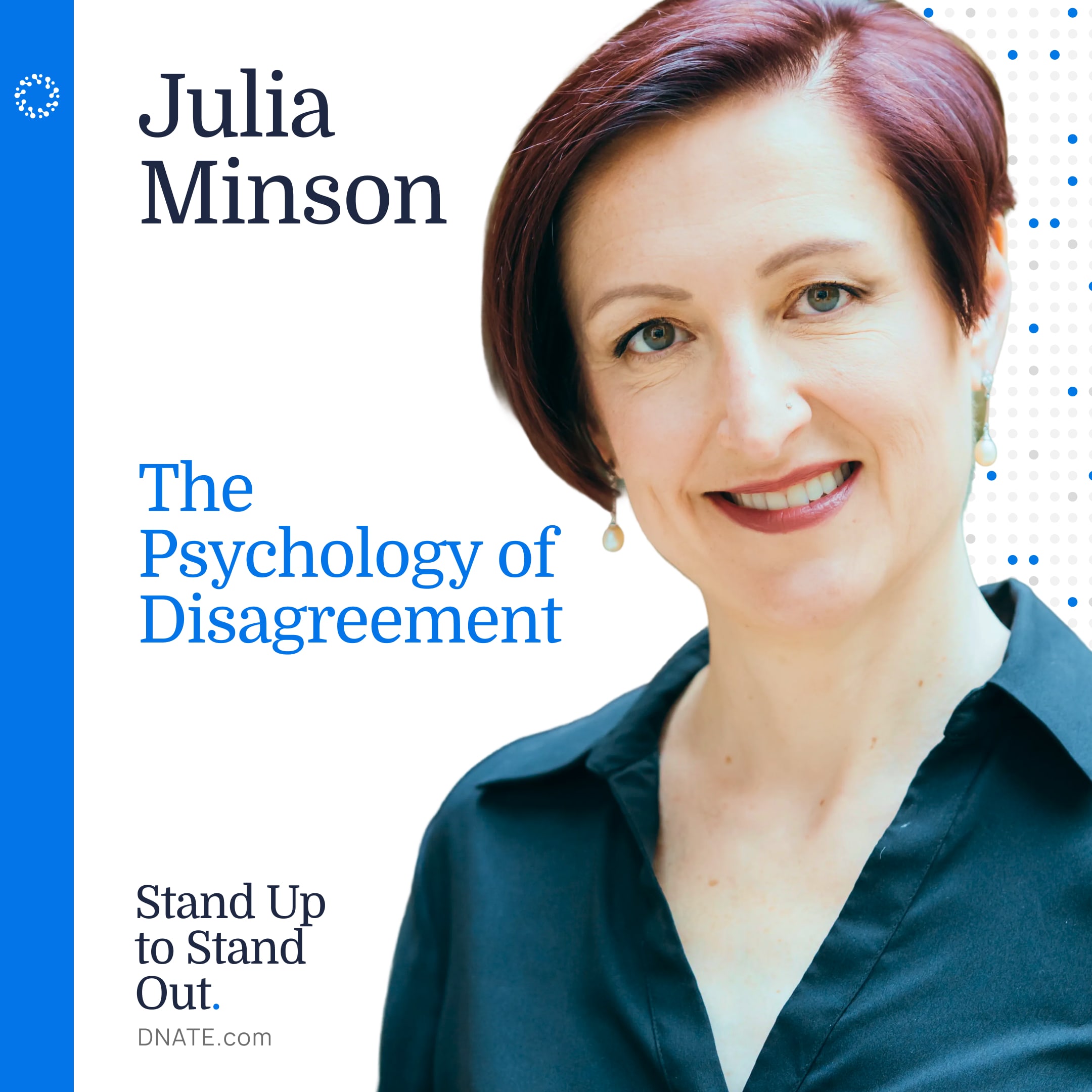
[00:00:10] Speaker B: My guest today is Julia Minson. She is a professor of public policy at the Harvard Kennedy School of Government. She is a decision scientist with research interests in conflict management, negotiations, and judgment and decision making. Her main research addresses the psychology of disagreement. How do people engage with opinions, values, and judgments that conflict with their own? And she is the founder of Disagreeing Better, llc, a behavioral science consulting firm that offers speaking and training on effective management.
Please welcome Dr. Julia Minson. Hi, I'm Stuart Papp, founder of DN8, and welcome to Stand up to Stand Out. The podcast communication has changed my life, and it will absolutely change yours, because breakthrough innovating deserves curves, breakthrough communicating. Every episode, we bring you industry insiders, subject matter experts, and you can learn from my decades of experience to get the most practical and tactical advice that you can put to work. Now, let's dive in to today's show.
I am delighted to have Professor Julia Minson on the show. We have so much to get to, and, of course, congratulations on your upcoming book. I've ordered multiple copies.
[00:01:30] Speaker A: Thank you, Stuart. I'm delighted to be here.
[00:01:33] Speaker B: So let's get into. First of all, I'd like to understand a little bit your background and interest in this area.
Even when I read the word like disagreement, my heart starts to flutter a little bit. I get nervous. I feel like this is something that most people get uncomfortable with. But I'd love to understand your background and getting into the subject area and then ultimately to your teaching and consulting work in this.
[00:01:58] Speaker A: Yeah, absolutely. So, you know, I've been interested in disagreement almost as long as I can remember. I think part of it is it's an experience that we can't avoid. Right. Every single person, every single day disagrees with somebody about something. Right. Whether it's in our family, whether it's in our community, whether it's in the workplace.
As long as you have people around you, they're going to have different opinions.
And I just remember even as a teenager and, you know, starting out my career thinking about everybody has an opinion and everybody thinks they're right. And isn't that fascinating? Because that can't possibly be true all the time.
And that's kind of what, you know, got me going on this, because it's just something we encounter every day.
[00:02:46] Speaker B: So maybe we could start with some foundational definitions. You know, when I see disagreement, it feels neutral and there's argument and, you know, there's fighting. And you can really go in multiple directions just to level set. What. What do you mean by disagreement?
[00:03:03] Speaker A: Yeah, so that's, I think, a great question because part of the trouble we have with like these dynamics where different opinions encounter each other is that we use a bunch of terms that are confusing because we all sort of use them differently.
So the way I think about it is that disagreement is anytime two people have a different opinion, right? So it could be a different preference, right? Like I like cats, you like dogs. It could be a different prediction about the future. You know, this product will do incredibly well on the market, whereas you think that this product is going to flop.
It could be a different set of values. You know, I believe that freedom is the most important thing and you believe that safety and security is the most important thing, right? And so in each of those cases, we hold different beliefs, different preferences, or different predictions about the future.
And you could imagine that for any of those types of differences, you can have a totally reasonable, totally civil conversation about it, right? You could sort of imagine, you know, even something that seems sort of morally laden and politicized, right? Sort of freedom versus security.
Sitting down, you know, with a friend, you know, over a glass of wine, having this, like, interesting philosophical discussion about which thing is more important.
And that is great, right? When people have different views, that's how we get new interesting ideas, right? Especially in a professional context, especially in our civic spaces, we need people to disagree. The whole point of having different people in a room is that they bring different opinions and different ideas to the table.
Now, when you said that, you get sort of this little flutter of discomfort and stress when you think about disagreement. You're not really thinking about disagreement. What you're thinking about is conflict.
I think of conflict as a very different set of dynamics, which is like disagreement plus. Right? It's like disagreement plus some extra stuff.
And usually that extra stuff is this idea that I can't let you continue believing whatever it is you believe, right? Your idea is terrible, or your belief is unreasonable, or. Or your values are sort of antithetical to my values, and therefore I'm going to go and change your mind.
And what normally arises out of that is negative emotions because of course, you don't want your mind changed. You are quite happy with your mind exactly as it is, right? So if I want to change your mind and you don't want your mind changed, then we're going to have a problem.
So you end up with some negative emotions that come from the frustration of the fact that I'm telling you how things are and you're not changing your mind.
And often there's sort of negative beliefs that we form about the other person. Because why isn't Stuart changing his mind? Like, I'm telling him good facts and he is just dug in. What is wrong with this person? Right? So disagreement, totally fine.
But once we sort of change, try to change each other's mind by force, and all the kind of cascading consequences of that, that's what I think of.
[00:06:35] Speaker B: As conflict, how do we then seek to change or persuade people in a way that will make them want to see it a new way?
[00:06:44] Speaker A: So, you know, that question is really interesting in part because I think of it as the wrong question.
[00:06:53] Speaker B: Okay.
[00:06:54] Speaker A: Most people have that intuition that when you go into a disagreement, the purpose is to persuade and to change the other person's mind. And that could be a purpose, right? That could be a thing that we could do, but there's all kinds of other things we could do. And I think part of the problem is that most of us don't stop long enough to consider, why am I having this conversation, what am I trying to accomplish and what is realistic to accomplish, right?
Most of the time, changing a person's mind in one conversation is just not a realistic goal, right? Like, it's just not going to happen. But there's all kinds of other things we could be doing. Probably the most productive thing we could be doing is trying to understand why the other person believes what they believe, right? So if we assume for a second that the other individual is like a reasonable, intelligent human, you know, if we are in a professional context, here is a person that was brought into this organization or brought onto this team because they have something to offer, right? Some expertise or some insight, or they represent a set of stakeholders. What is from that experience and that training and that set of beliefs that's driving them to disagree with me in this particular context, right? What is sort of the actual nature of the difference? What is the evidence they have? Why does it matter to them? Right? Like, why are they stuck on this idea? And I think quite often we don't think of these different goals we could pursue in a disagreement. You know, I've just sort of mentioned the goal of persuasion as being relatively unrealistic. I've mentioned the goal of learning as being sort of good and productive and useful. You can think of other things, right? You could think of the goal of impressing this person. This person is my boss, and I'm going to disagree with them. In a way that makes them think that I'm smarter, better, more competent than however they thought of me before.
Right. My goal could be to just reinforce the relationship, say, hey, you know, this is a person I need in my life, so I'm going to disagree with them in a way that makes them trust me more, like me more, makes them feel more comfortable and secure around me. It could be that I, like, don't really want to deal with this in the first place. Right. We sort of have a disagreement, but I'm realizing, you know what, this is not good for me and my ultimate goals. So my goal in this conversation about this disagreement is to just, like, walk it back and get out of it. Right.
Most people don't stop to consider those goals, and we all, like, default to this thing of how can I force the person to change their mind?
And I think that is a really important dynamic to notice and to try to manage in, like, a thoughtful, intentional way.
[00:10:00] Speaker B: You bring up intent. Let's take the example that you mentioned, where there's somebody who is seeking to disagree with their boss to demonstrate their, you know, intelligence, their critical capacities, their strategic thinking.
How can you ensure that your intent of arriving at a better truth, a better outcome, is being received by the other party? And I say this because, and I'm sure you encounter this all the time, people are very aware of power dynamics and personality dynamics and let's call it internal politics. And I could go on, and thus there's sort of the objective pursuit of, you know, getting to disagree better. And then there's the subjective experience of someone challenging my authority or somebody who's justifying their paycheck or. And we could go on like this.
So can you help understand or unpack the power dynamic that could interfere with your intent?
[00:11:03] Speaker A: Yeah, I think, you know, I think being aware of the power dynamics and being aware of sort of, you know, what's the game you're playing is incredibly important.
And I like.
I like thinking about intent and being sort of honest and thorough with yourself about what do you actually know and what do you not know?
Quite often what I see happening in conversations is people making assumptions about the other person and, you know, the dynamics at play and their, you know, intentions, even if those intentions are totally different, what the other person just said. Right.
So you often see this.
Well, you know, they are just doing that to justify their job, or they're just doing that because they are on an ego trip, or they're just doing that because, you know, they never prepare for meetings and they didn't prepare for this one either. Right.
And I think in general, anytime that you think that you are like, you know, the smarter, wiser, harder, working, better human being in a conversation, it's time to stop and question.
Right? Because presumably the other person is thinking the same thing, and both of you can't be right at the same time. So, you know, roughly half the time when you're feeling like superior to your conversation partner, you're wrong about that.
Both people are feeling like, you know, I get it, and the other person is the one who is kind of, you know, out to lunch. And so I think a really important feature of accomplishing your goals and conversation.
Right. Is sort of honestly asking yourself, like this person who is asking me to, you know, write this, like, ridiculously long report, you know, that's going to sort of waste my weekend on nonsense.
Are they really, you know, sort of wasting time in order to justify their department budget or, you know, are they following a set of regulations that they have to follow? You know, have they had an experience in the past where, you know, a client was frustrated with, you know, lack of detailed reporting? Right. Do they know something about this project that I don't know that leads them to, you know, think that this thing is important that I don't fully recognize? So I think there's a big.
There's a big job of sort of questioning our assumptions about other people, especially when those assumptions are negative.
[00:13:48] Speaker B: It makes me think that, you know, where do we have forums in life where you can have a safe disagreement? And I think of a courtroom. Not. Not a perfect proxy, but there's a judge and there's opposing parties, and there's sort of rules of engagement. But, you know, real life is messier, and real life doesn't have all of these rules.
I walked into my kitchen, I saw Judge Judy there. I. I'd be thrilled. But it also be, you know, it's not. It's not reality. Right. We. We are humans. We're. We're engineered to break down. We get upset. We're emotional, you know, all of that, let alone the power dynamics. So my question is, you know, I want to be able to disagree better. I think most people want to be able to in pursuit of a greater truth.
How can we get started with this? What. What are some ways that we can do this in the real world with our spouses, partners, bosses, colleagues, friends, you name it.
[00:14:48] Speaker A: It's interesting you're naming a couple different, very important features of disagreement that a lot of people don't think about.
And one of the things you're naming is the context. Right. What are all the features of the situation you're in that make it harder or easier to disagree? Well, right. So court has rules.
And, you know, the rules don't always make things easier for people, but, you know, if you're a trained attorney, at least you know the rules. Right. Your kitchen doesn't have rules. Right. It's sort of like people walk in and they start talking.
[00:15:23] Speaker B: Actually, we did put up a post it note that said house rules, but you wouldn't know that, of course.
[00:15:28] Speaker A: Well, so that's, you know, that's like smart. Right? Just like people have rules about, you know, no smartphones at the dinner table. Right.
Or, you know, like, don't argue with me before I've had my coffee. Right. These are all rules that in some sense we just like, we make up ingest. But it's, it's useful to think about how can I structure an environment to make this conversation go better. Right. So there are some things that, you know, so like, as soon as you say them, they're kind of obvious, but again, we don't think about it. So, for example, don't have an important conversation about a topic of deep disagreement in front of an audience.
Right. So we have Thanksgiving coming up. If you profoundly disagree with somebody in your family about politics, about parenting, about, you know, your mutual responsibilities to an aging family member, don't do that over the dinner table with six other people looking up. Right, Right.
Don't have disagreements when people are tired, cranky, hungry, under the influence of alcohol. Right.
Those situations kind of rob you of your ability to manage your emotions.
And if you're serious about a conversation going well, then, you know, none of those, none of those features kind of like help you. Right. Do have a disagreement one on one at a time that both people agreed on. Right.
So I hate situations where somebody comes to me and says, oh, by the way, I wanted to talk to you about something that's been really bothering me. And I'm like, wait, what? I. I was having a perfectly good day.
Why are we in this all of a sudden?
[00:17:24] Speaker B: Yeah.
[00:17:25] Speaker A: Right. So it's really sort of kind to give people some notice and say, hey, let's have coffee, you know, tomorrow I'd like to talk to you about the budget or the kids or this thing you said about Taylor Swift two weeks ago. Right.
If you give folks some warning, you have a much better chance of having that conversation. Be productive, because everybody's kind of like in the same mental space.
[00:17:59] Speaker B: So any other rules? I'm just assembling what you're saying into sort of a checklist to prepare because I'm interested in conversations where we're seeking the truth of the situation.
So what would go on that a context, I think rules, Notice, notice what else would be integral to managing a productive conversation.
[00:18:22] Speaker A: So I think, you know, the second big piece is what actually happens in the conversation, right? Like, once we've decided that we're going to have this conversation where one on one, we are, we've both agreed to have it.
We're not sort of tired, cranky, tipsy, right? We're like in a good space.
What happens then?
And I think, you know, this is where as a researcher, I really like to think about sort of systems and frameworks, right? So conversations around disagreement are not these like mysterious, squishy things, but really have, you know, parts.
What we do in a disagreement is mostly one of two things, right? Either you are seeking information or you're conveying information. Like there's very little else to do. What people spend much too much time on is the conveying information part, right? I'm going to tell you how it is. I'm going to tell you all the arguments for why I'm right and you're wrong and, and why, like, your plan is terrible and why this is not going to work and then give you a mountain of data about why my way is better.
[00:19:37] Speaker B: I'm sorry, were you just quoting my inner monologue? That's exactly right.
We all, like, it's so common.
[00:19:44] Speaker A: We all do this. We all do this. And it's, you know, it's totally natural and sort of like, almost inevitable. Because if you didn't think you were right, why would you be disagreeing? Sure, right. Like, the whole reason we're in this conversation is because I think I'm right. And so one task is to try to, like, switch the balance of time to how can I spend less time on the conveying the stuff in my brain and more time trying to seek out the stuff in your brain, right?
So, you know, you know not to say that you like, never get to talk, right? Because again, you have things to say. But how can we sort of like shift the balance a little bit? So I go from like 90, 10, talking about my perspective and like asking one perfunctory question about yours to really deeply, sort of seeking to understand so that when I get to my point, I'm a little bit more equipped with information and I actually do know what I'm talking about. Right, right. So I think that's one piece of it, that's kind of like a high level structural piece of it.
And then the question becomes, well, are there sort of concrete tools that you can use during information seeking to be better at it and during sort of like the information conveying, Right.
[00:21:15] Speaker B: Do you want your team to have a seat at the table?
Would you like your team to speak with clarity, confidence and influence? Reach out to us DNA.com for more information.
[00:21:27] Speaker A: A lot of the research that I do in my lab has to do with running experiments on different approaches to conversation and figuring out which ones work better, right? So you literally sort of like randomly assign different people to do X or Y and you see, you know, who has better conversations, right? Or who is evaluated more positively by their counterparts. And you say, oh, okay, this works better than that. Now let's all do this, you know, and so you uncover a lot of things through that method that are like, on one hand, what we've been telling people all along, but on the other hand are a little bit of a twist or a nuance, right?
So one example that I always find really striking is that, you know, in kind of like leadership training and communication training, we often talk about the value of curiosity, right? So that information seeking piece, right? Like, how do you show up in a way that sort of, you know, curious, open minded, kind of seeking the other person's perspective?
And one of the things we've learned from our research is that people in disagreement don't expect their counterparts to be curious or open minded, Right. They expect to be argued with, which is not surprising because we, you know, we've sort of talked about how people, you know, have this like, real narrow focus on arguing as the goal, right? And we all know that about each other.
So when you come in and try to be curious, I basically don't believe you. Like, I don't believe that you're that curious. I don't expect you to be curious.
In fact, in our studies, most people claim that they're twice as curious as the other person, which, like, is mathematically impossible. Everyone's got all the twice as curious.
[00:23:26] Speaker B: Yeah.
[00:23:26] Speaker A: So the question becomes, like, how do you fight this uphill battle, right, with this person who doesn't believe in your, in your curiosity.
And it turns out that what works remarkably well is just saying it with words, right. Instead of like trying to tweak your brain to be more curious, you know, or try to sort of like use your body language to convey curiosity.
You can just say things like, I'm really curious about your perspective. I like to understand where you're coming from. Right.
And, you know, I understand this as a hard topic, and I understand that we disagree.
Tell me more about why you believe what you believe.
What's interesting about language is that, first of all, people notice it because it's external to our. Our brains. Right. People can't read your mind, but they can sort of hear and read your words. The other thing that's sort of really important is that we often give ourselves credit for doing things in our heads that we are not doing quite successfully. Right. Like, I'm trying to be empathetic, but, like, am I being empathetic enough? Yeah, probably good enough. Right. But when you kind of hold yourself to a standard of I have to express my curiosity verbally in a way that my counterpart notices and recognizes, it's harder to give yourself credit for a thing you fail to do.
Right. It's like if you hold yourself to an external, measurable standard, you're much more likely to actually perform it.
So a lot of my research is really pointing to the value of expressing your desire to understand and your desire to learn about your counterpart in, like, incredibly clear, repetitive words.
[00:25:24] Speaker B: So it's not only benchmarking that you are curious, but signaling to your partner, your conversation partner that you are curious to give them the clear signal. So it seems as it's. It's twofold. You have to really benchmark yourself and hold yourself to an account, and you have to signal to your partner that you have that genuine curiosity.
[00:25:46] Speaker A: I think you're almost reaching. You're almost reaching for, like, a higher bar that I am. That I'm aspiring to. You're saying, you know, genuine curiosity and signal that to your partner. I'm not even sure how genuine it needs to be, honestly.
[00:26:00] Speaker B: Okay, you know, disingenuous curiosity, right? I've been faking my. My. I've been faking my sincerity.
[00:26:07] Speaker A: Yeah, that's fake until you make it.
[00:26:10] Speaker B: Okay, so this works.
[00:26:13] Speaker A: It works. It works because, again, you know, if you are, imagine. Imagine this situation. Again, imagine that power dynamic situation where, you know, you are in an important conversation with a client, right? Or with your boss and you're really frustrated with them, right? But, like, you know, you've listened to this podcast or, you know, you've read my upcoming book, and you're like, I need to signal curiosity, right? Like, in my head, I want to, like, choke this person right now, but I need to signal curiosity because Julianne Stewart said I'm supposed to do this Right. And so you say something like, look, this is a really hard topic, but I'd like to understand where you're coming from.
[00:26:59] Speaker B: Okay.
[00:27:00] Speaker A: Right. They have no idea that in your head you're, like, incredibly frustrated and have absolutely no interest in their perspective. What they're hearing is. You'd like to hear where they're coming from.
[00:27:12] Speaker B: Okay.
[00:27:12] Speaker A: Right. Then they explain, and then you might learn where they're coming from and then things might go better. Right.
You know, I always say that, like, faking your curiosity is far better than expressing your genuine irritation.
[00:27:28] Speaker B: So you're engineering a better conversation. I'm curious though, because non verbal cues can signal a disconnect. Right. So we've all seen the person who says, yeah, I'm thrilled to tell me all about what you're doing. Right. With this Passover. Right. So we all have that experience.
Obviously this is not that, but it seems as what you're saying that you can signal.
You don't have to feel that way, but you can demonstrate curiosity with the words and it will do the trick to evoke a, A, A response from the other party and then get you closer to what you're ultimately trying to achieve.
[00:28:07] Speaker A: Yeah, yeah, I. That's exactly right. And I think, you know, there's a couple ways of thinking about it. I mean, one, the person who is like, you know, faking curiosity, for lack of a better word, is still trying.
Right. Like they're, they are doing something to have a better conversation.
[00:28:26] Speaker B: That's going to be the next book. Faking Curiosity is still trying. Okay, okay, let's consider it. All right. I. It's compelling. It could be the podcast title. Kidding. I'm kidding.
[00:28:38] Speaker A: I. Well, right. Exactly right. Like, there's a lot of times when, you know, there's people who don't try it all.
There's people who do things from the genuine depth of their soul, and then there's people in the middle who maybe, you know, don't feel. Don't feel it deeply, but are still doing their best to create a positive conversational experience for everybody involved. I think those people should get some credit. Right. I think that's one piece of it. I think the other piece of it is those situations where we think of where our body language goes in like, full opposite direction from our words are actually incredibly rare. It's quite difficult to do.
Right.
When we picture that situation, what we're picturing is sarcasm.
Right?
[00:29:29] Speaker B: Yeah.
[00:29:30] Speaker A: And you know, of course, when you're being sarcastic, what you're trying to do is you're trying to convey the fact that, you know, you don't think much of this person, you don't think much of their argument, and you're like, yeah, fine, I will go to dinner with your mother. You know, and like, you're like, saying words that mean, fine, I'll go to dinner with your mother. But you're rolling your eyes way to the back of your head to show how full of disdain you are for this idea. Right, right. That's an intentional move. Right. That's very different than I'm going to try to express curiosity even though I don't, you know, feel it in the depth of my soul.
[00:30:11] Speaker B: Right.
There's something so compelling about someone who's curious about want someone else because it's, it signals that you like someone, that you're open to them. And, and I can't help but think that it, it softens their resistance to you. And that ultimately when, when we're talking about what we're talking about this concept of soft negotiation from psychology, that every conversation is kind of a soft negotiation and there's an objective.
I can't help but think that in, in almost every case, tell me more about or I'm curious about is a universal sort of master key that unlocks the other party to be more open to you, more receptive to your ideas, and it just kind of starts to bring you closer and more connected.
[00:31:01] Speaker A: Yeah, that's. That's exactly right. The reason people talk is because they want to feel hurt.
Right. If I didn't want you to understand where I'm coming from, there would be no point sort of having a conversation.
[00:31:14] Speaker B: Right.
[00:31:15] Speaker A: And so when you look across world cultures, there's a ton of research that basically shows that people really like that feeling of feeling hurt. Right. And so the question becomes, how do we give them that feeling? Right. We know that, like, in the organizational behavior research literature, you know, people are less likely to quit their jobs if they feel their manager is, you know, if their manager makes them feel heard. We know in healthcare, patients are more likely to adhere to their medication if they feel heard by their doctors and.
[00:31:51] Speaker B: Less likely to sue.
Right. For malpractice.
[00:31:54] Speaker A: Right, right, right, right, right. This, like, squishy, you know, soft skill thing has these, like, incredibly powerful real world effects. And so the question is, how do we give people that feeling? Right. How do we create that impression that we are, in fact, hearing them?
[00:32:15] Speaker B: That's a magical phrase. And I just want to reflect on that because I feel like what you just said is, for me, a North Star that, that going into every conversation, if my objective is to make them feel heard, I think that's a good goal to have in any conversation.
[00:32:36] Speaker A: Right, exactly. Exactly.
[00:32:38] Speaker B: You know, I, I work a lot with teams and they're in various aspects of healthc care, but oftentimes they have to speak with physicians or clinicians and, and I say to them, you know, the first thing you have to appreciate is if they're willing to even speak with you because they have agency and, and autonomy.
That's already a massive win.
Like just the fact that they're in the court with you or on the playing field or whatever your analogy would be. I, I feel like that is such a win that if somebody is just even willing to engage that you should take that as just a, a gift and not squander it.
[00:33:17] Speaker A: Yeah, that's exactly right.
As an academic, I like things to be relatively precise and clear.
And one of the things I started thinking about a while ago was this idea of constructive disagreement.
Everybody's into constructive disagreement. What do we mean? What are we constructing? How do we know a disagreement is a constructive one?
And to your point, I think of constructive disagreement is any disagreement that leads us to have another conversation.
Right. Because it is incredibly easy to destroy a relationship in one conversation and make that person say, you know what? No, I'm not going to give this my time in the future. We're done. Right.
What can you do to have one more conversation? Right. To make this other person feel that talking to you is valuable.
[00:34:14] Speaker B: Yeah.
[00:34:15] Speaker A: Or at least not awful.
[00:34:17] Speaker B: That is golden. That is just beautiful. And it reminds me of something that, you know, the owner of my, my gym, where I go most days, he says the right workout for you is the one that brings you back tomorrow. So don't go crazy with this. And I think that yours is, is far more elegant.
And it's so easy nowadays to isolate yourself, cut people off, delete them from your friends, unfollow whatever you want. It's just, it couldn't be easier. And yet we need each other more now than ever. There's my after school special moment. But I truly believe that the future is predicated on us working together better. It's what we do as humans. It's our superpower.
And anything that will bring you back to a conversation is the most important metric that you could go on. Not if they see it your way or how long the conversation was, or if they high fived you, are they willing to speak with you again? And do they show up again? I couldn't think of a higher standard.
[00:35:16] Speaker A: Right. And, you know, I agree with you that almost every problem that is sort of serious and important and difficult requires multiple people to solve it. And more and more our world is full of problems that, you know, cannot be solved alone. Right. I mean, everything about our lives has gotten complicated enough that like, you know, I mean, there's almost nothing in my house that I know how to fix by myself. Right.
[00:35:51] Speaker B: Yeah.
[00:35:52] Speaker A: We're at a point in life where, you know, it takes like, you know, 20 different kinds of professionals to just, you know, make one, like home run.
So that ability to work with other people who have different knowledge.
[00:36:10] Speaker B: Yeah.
[00:36:10] Speaker A: Is absolutely crucial. And there are few things that are kind of more important to, you know, personal, well, being professional success than being able to comfortably talk to people who wildly disagree with you.
[00:36:26] Speaker B: I couldn't agree more. And the reason I'm laughing is about 15 years ago, there was a TED talk that I think everyone should watch. It was done by a guy named Ted Ths and it's how I built a toaster from scratch. And he basically, I don't know if you've seen this one, but he sources every raw material that go into the most mundane home appliance of all, the toaster.
And it, it's staggering because I always think about this, that most people, we take it for granted. All the technology, all the infrastructure, all the, the rules, the laws, the. You know, it's just every day is a miracle that would absolutely shatter the minds of da Vinci and Newton and anyone else. And we just take it for granted. And we just have so much opportunity when we multiply and, and geometrically the impact we can have when we're, when we're collaborating, I don't want to say cooperating, but collaborating.
And I thought of a mental model of disagreement that at first, when I thought about disagreement, I was thinking about the opposite of agreement. But I almost think of it like a Mobius strip where if you start on one angle, I think the purpose is to sort of go on the journey and maybe you end up on a different side of that strip. And that's okay if it's enriched your world and their world and the possibilities of what you can do.
[00:37:52] Speaker A: Right. So, you know, there's two ways to think about disagreement. A lot of my teaching at the Harvard Kennedy School is teaching sort of introductory negotiations. Right. All of our incoming master's students have to take an introductory negotiation course.
And in negotiations, there's sort of this, you know, concept of like zero sum negotiations versus value creation. Right. So zero sum negotiation is, you know, there's a pile of goods and we're trying to divide it. Right. And the more you get, the less is left over for me. Right. So it's kind of a tug of war.
So I think of persuasion as a zero sum negotiation.
If I persuade you, you have to give up your perspective. And if you persuade me, I have to give up my perspective. Right.
And so there has to be sort of like a winner and a loser. Right. Whereas you could imagine a conversation that's much more like a value creating conversation. Right. Where both of us are winning because both of us are learning about the other person's perspective.
[00:39:01] Speaker B: Right.
[00:39:02] Speaker A: I don't actually have to change, change my mind in order to fully and deeply understand where you're coming from and make you feel like I sort of appreciate and recognize your perspective. Right. And you don't have to change your mind either. So we can both walk away with more information and more insight and both feeling like we had a very positive experience without anybody having to back off of anything they believe.
[00:39:32] Speaker B: You know, I refuse in many circumstances to see things as a cost and I more reframe them as an investment because an investment has an expected return.
And I think most things we, we determine cost. What's the energy bill? Well, what is there an expected return? Was there value created far beyond just the consumption or production of electricity? And you can sort of take that, that calculus and go throughout. But I think what you're saying and is something more beautiful and elegant, which is we need to get away from this transactional I win, you lose. Or you know, scraping out 51 cents, you get 49. Look how I won. And more. What can we do with this? What's possible? And not only now, but in the future. You look at healthcare or any industry, you know, they're playing 15, 20 years into the future. And so that's very abstract. I mean tomorrow's abstract, even today. So we have to kind of change the way we think about what we can do together better.
I wanted to the last piece here before I let you go and I really could go for hours here because I just find it fascinating. But I would love for you to unpack this here framework H E A R And it's something that I know, I don't know if it's in your book, but, but I find it incredibly helpful and I read it in an article that you wrote and, and so I was hoping you could explain that and how you would use this tool to have better conversations and Disagree Better.
[00:41:05] Speaker A: Yeah. Okay, great. Great question. I'm glad you're raising it. It is in the book.
The book is called how to Disagree Better, and it is coming out in the end of March.
[00:41:16] Speaker B: Yeah, got my copies. Cannot wait.
[00:41:21] Speaker A: So we remember, we talked a couple minutes ago about this idea that conversation across disagreements sort of has two parts. The, you know, seeking information, the conveying information.
And imagine you did a great job seeking information. You asked lots of curious questions, right? You sort of work real hard to understand where your counterpart is coming from. But then, like, at some point, you got to get to the conveying thing, right? You gotta say, well, here's why I believe what I believe.
And there's a real risk there, which is that you're going to lose all the goodwill that you have just built up, because once you start arguing your point, it's going to, once again, go back to sounding like an argument. And so this is where the HEAR framework comes up. The HEAR framework is kind of a shorthand acronym for a technique we call conversational receptiveness.
It's a way of using language to demonstrate to your counterpart that you're still kind of actively engaging with their perspective even as you're making your own point.
So here the acronym stands for hedging, emphasizing agreement, acknowledging the other perspective, and reframing to the positive.
So these are sort of four things you can be doing with your words as you are expressing your own point of view. So hedging is words like sometimes, possibly, perhaps, right? So I could say something like, Covid vaccines are safe and effective. Right? That's, let's say, the statement that I want to make, because I believe it. I could also say most physicians tend to believe that Covid vaccines are largely safe and effective.
So I just crammed like three hedges into one sentence, right? I still said the same thing. The person knows exactly what I personally think about COVID vaccines from that statement.
But I did it in a way that recognizes sort of the little nuances and little exceptions to the general claim.
And that makes my counterpart sort of less eager to argue with me about it, right? Because I sort of already acknowledge the fact that I get that there's another side to this.
The E is emphasizing agreement. The idea is that when we hear an opposing perspective, it's really easy to jump right into dissecting the disagreement. But you can take a few seconds to show your counterpart that you have some values that, you know, both of you hold, right? So emphasizing agreement doesn't mean compromising.
It means saying, look, we both want to work in a company that provides shareholder value while supporting employee well being, or I agree that the last few years have been really hard, or we both want to find a way to make this possible policy work for everyone, right? So it's finding some underlying agreement that kind of puts you on the same side. The A in here is acknowledgement. So this is the one that I think most people have sort of heard of either like in family therapy or in like a corporate training. The idea is that you want to take a second to show your counterpart that you really heard the thing they just said.
Quite often people are a little bit lazy about it, right? So you say something like, I hear you, but here's why we can't do that.
Acknowledgement done a little bit more artfully involves actually using your own words to demonstrate with your behavior that you heard your counterpart. So I hear that you are really concerned about the client relationship and that you have received some feedback that makes you worry that the client is unhappy with the timeline, right? So I didn't just claim that I heard you with no evidence. I showed you that I heard you with my words.
And then the R basically does double duty. So R stands for reframing to the positive. And the idea is to try to avoid kind of like negative contradictory words.
So no, can't, won't, don't, terrible, hate, right? And replace them with more positively valence words. So instead of saying, I hate it when people force me into rushed decisions, you can say, I really appreciate it when people give me enough time to consider important decisions, right? So I said the same thing. I said give me more time, but I said it in a different tone.
That kind of leads to an overall like more positive flavor, right? So hedging, emphasizing agreement, acknowledgement, and reframing to the positive.
[00:46:30] Speaker B: What occurs to me about the double stack of really first being curious and signaling, all of that, and then here framework, which is elegantly stated, is that most of your work is really just spent being an archeologist to understand who they are, what they believe, why they believe, what they believe, making sure that they understand that you understand them. I mean, so all of that has almost nothing to do with being articulate, you know, rhetorically persuasive, whatever it would be. Or you know, it just is more being a rich, deep, curious, empathetic human who cares about something bigger. Maybe get coming back to these discussions, above all else, it sounds like the right, the right goal to pursue.
It also feels like, okay, how do I reframe all of my conversations through this lens of deeply understanding, being curious and, and ensuring that they understand my intent and acknowledge who they are and what they are about. That seems to me the. The calculus to be a. A connected human that gets things done.
[00:47:48] Speaker A: You know, And I think what's interesting about that is that a lot of, you know, a lot of your listeners are going to say, yeah, I get it. Like, of course that's the right thing to do.
And then the interesting question is, why aren't we all doing it?
Like, in some sense, you know, like, I like to sort of, you know, celebrate big Harvard science, But these are not revolutionary ideas, right? Why aren't all of us doing this all the time?
And it's a good question to think about because people do have objections, right? And some of those objections are sort of like, really worth considering because if we, you know, in the name of curiosity and receptiveness to opposing views, if, you know, we are sort of on this project of, you know, asking people to be more curious and have these more constructive conversations, but not everybody's doing is to some extent on us to ask them why aren't they doing it, you know, and the answers are often sort of, you know, sensible things that we should really consider. Like, you know, leaders, for example, are often concerned about, you know, is this going to make me look weak? Right. Is this going to make me look uncertain? Is this going to make me look like I am not actually sort of in charge of the room or in charge of the conversation?
The answer is, no, it's not. It's like a totally reasonable, sensible concern, and it is sufficiently reasonable that we've collected data on it. We can compare speech by, you know, leaders who express curiosity and receptiveness versus people who sort of sound much more dogmatic. And expressing curiosity and receptiveness makes you come across as a better leader, right? So that's just like, you know, an empirical answer to a question that I hear all the time. You know, another thing that I think people are often very concerned with is if I'm receptive and curious to something I really, really hate that I might find sort of morally abhorrent, am I platforming that view and kind of like giving it breath that it doesn't deserve, right?
And so again, it's not an objection that we can just say, oh, don't worry about it.
Right? It's an objection we need to take seriously.
The way I often think about it is that, you know, not everybody needs to be in every conversation, right? There's certain things that people might say to Me that I will say, you know what? Nope, I'm not talking about this. Right. Like, not okay, my mental health is not worth it. But again, that's sort of a conscious choice.
[00:50:46] Speaker B: Right?
[00:50:46] Speaker A: Right.
It's not a reflex. It's a conscious calculation of is this relationship worth it or not. And sometimes it's not.
Right.
[00:50:58] Speaker B: One quick observation here and final question coming up. But you know what? You spoke about that leadership quotient of signaling open openness and open mindedness and curiosity at the same time. I think it also has to live with competence and decisiveness and, and direction. But when you get those two together, it makes a, for a very powerful, charismatic leader, somebody we, we trust, we tend to follow because they, they feel deeply human, but also have a direction and, and a goal and a purpose and, and it reminds me a little bit of Daniel Coyle's work on high performing teams. So he wrote the culture code and the talent code. But one of the things he mentions in the culture code, he studied high performing organizations around the world was it, it was predicated on three core ideas.
And the first was vulnerability.
And being vulnerable is saying that you've changed your mind, that you've seen it a different way. And I just heard some, a physician talking how often that they've changed their mind. And, and almost I feel like that you could have like a change log track record that you could make transparent to show that as a human this is how you've changed your mind. But it hasn't hampered your goal, your purpose of going across the ocean or whatever your mission is. It's only accelerated it. And I think when people see those two together, it, it makes for a rich calculus to, to make for an effective leader.
[00:52:37] Speaker A: Yeah, yeah, no, that's exactly right. I think, you know, I'm glad that you bring up healthcare because I think healthcare is a great example where you can notice the fact that uncertainty and competence often go together.
Right. So if you think about any medicine, right. And any medical professional, they will never say, do this and your headaches will go away.
They will say in clinical trials, X number of patients with this profile, you know, observe an X percentage reduction of symptoms, you know, plus or minus two standard deviations. Yeah, right. And you know, a scientist, when they express uncertainty, right. When somebody says, you know, drink this and spin around in a circle and then your medical problems will resolve, that's when you know you're talking to somebody, you know, full of nonsense, right?
So we actually have a great appreciation of uncertainty as a signal of depth of understanding. Yeah, right.
And so I think sometimes we forget about that. And I'm glad, I'm glad you bring that up.
[00:53:57] Speaker B: So tell us about the book. It's coming out in March 2026.
As I said, I've ordered multiple copies and I cannot wait to dig in and to give it out to clients, to families and friends.
I'll read this so we can argue next week. Now, all kidding aside, why write this book? Why now? And tell us a little bit what we can expect from this book.
[00:54:20] Speaker A: Yeah, absolutely. So the book is called how to Disagree Better.
And that's literally what it is. It's sort of a manual for normal people about how to disagree better based on cutting edge behavioral science.
There are, you know, there are many books out there on conflict management.
We wanted to give the field a bit of an update based on what we know from experimental research, but we also didn't want it to read like a Harvard textbook. Right. So it's really a book that takes the ideas that were very carefully studied and applies them to people's everyday lives.
So a lot of the examples I have to tell you are from my family. Right. There are disagreements with my husband, their disagreements with my kids, their disagreements in the healthcare context, disagreements in the civic space, disagreements in sort of like leadership and management, the daily types of interactions that all of us have. So I'm really thinking of it as, you know, how can we take the research that my lab has been doing for the last, you know, 20 years and make it the most useful to as many people as possible?
[00:55:50] Speaker B: I love it. I love the utility. Well, Professor Julia Minson is a professor of Public policy at the Harvard Kennedy School of Government.
Before I let you go and thank you for your time and energy, I've just learned so much today. Where should everyone go to learn more about you and your work?
[00:56:10] Speaker A: So I have a company that offers training in constructive disagreement.
Our website is disagreeing better.com disagreeing better.com.
[00:56:23] Speaker B: All right, well, Professor Julian Manson, it has been an absolute pleasure to speak with you on Stand up to Stand out and look forward to speaking to you again.
[00:56:31] Speaker A: Thanks, Stuart.
[00:56:32] Speaker B: Hey, it's Stuart again. Before you leave, if you love this podcast, subscribe. And also if you go to dn8.com you'll find a sign up for our newsletter where we give you actionable and practical advice. And be sure to find us on social media. And don't be shy. You can give us a six star review, but we will settle for five. See you in the next one.
[00:57:04] Speaker A: It.